Louis Vuitton date code: a complete guide to reading and authenticating a vintage bag
Posted on November 04 2025

Updated October 10, 2026
The Louis Vuitton date code is a sequence of letters and numbers stamped inside the bag that indicates the workshop and the manufacturing period. While it helps date a piece, it does not by itself prove authenticity, as counterfeits reproduce them as well. Here is where to find it and how to read it depending on the era, from the 1980s to the chip that has replaced it since March 2021, with decoded examples for each format. To learn more, see our selection of authenticated Louis Vuitton bags.
What is a Louis Vuitton date code?
Contrary to popular belief, Louis Vuitton does not use serial numbers. The date code is a production code: it indicates the workshop and the period of manufacture, but multiple bags may share the exact same code. It is therefore not a unique identifier. And unlike other houses, Louis Vuitton does not provide an authenticity card with its bags. The date code remains a production clue, not proof of authenticity on its own.
Where to find the date code on your bag
Its location varies depending on the model and the era:
- Most often, it is embossed on a small leather tab sewn into an interior seam.
- On some models, it is stamped directly into the interior leather or inside a pocket.
- On vintage pieces, its location is more variable: you sometimes have to look near the seams or under an interior pocket.
A missing or faded code is not necessarily suspicious: vintage codes wear down over time, and since March 2021, Louis Vuitton no longer applies physical date codes.
How to read the date code by era
Before the 1980s: no code
Date codes appeared in the early 1980s. A piece older than that has none: its authenticity must then be verified solely by the materials, stitching, markings, and quality of craftsmanship.
Early 1980s: 3 or 4 digits
The first two digits indicate the year, and the last one or two indicate the month. Example: "832" = February 1983.
Mid to late 1980s: numbers + 2 letters
Same reading, but two letters appear to indicate the workshop. Example: "882 VI" = February 1988, workshop in France.
1990 to 2006: 2 letters + 4 digits, month/year reading
The digits are read in alternation: the 1st and 3rd give the month, the 2nd and 4th give the year. Example: "SP0065" → SP = France; digits 1 and 3 = 0 and 6, i.e., June; digits 2 and 4 = 0 and 5, i.e., 2005.
2007 to 2021: 2 letters + 4 digits, week/year reading
Same structure, but the 1st and 3rd digits now give the week of production. Example: "VI3058" → VI = France; digits 1 and 3 = 3 and 5, i.e., the 35th week; digits 2 and 4 = 0 and 8, i.e., 2008.
Since 2021: the chip
Since March 2021, the physical date code has been replaced by an electronic chip embedded in the bag, readable by Louis Vuitton.
Workshop codes and countries of manufacture
The two letters of the date code indicate the workshop, and therefore the country of manufacture. Here are the most common codes (the lists published vary slightly from one source to another):
| Country | Common codes |
|---|---|
| France | AR, BA, CT, DU, FL, MI, RA, SD, SP, TH, VI… |
| Italy | BC, BO, CE, FO, MA, RE, SA… |
| Spain | CA, GI, LB, LM, LO, UB… |
| United States | FC, FH, FL, LA, OS, SD, TX |
| Switzerland | DI, FA |
| Germany | LP |
Important note: some codes, such as FL or SD, have been used in both France and the United States. This is why the date code is never enough on its own: you must always cross-reference it with the "Made in..." marking present on the bag. An inconsistency between the two is a major red flag.
Other clues for dating and verifying a bag
- Model/era consistency: every model has a launch date. A Neverfull, launched in 2007, cannot have a date code earlier than 2007.
- Code/marking consistency: the country indicated by the letters must match the "Made in..." on the bag.
- Materials and finishes: the evolution of leathers, canvases, and linings over different eras also provides clues about the manufacturing period.
The special case of "The French Company" bags
A detail unknown even to some enthusiasts: from the late 1970s to the early 1990s, some Louis Vuitton bags were made in the United States by The French Company under a special license from the house, and sold notably at Saks Fifth Avenue and Neiman Marcus. These pieces feature differences in finish compared to models made in France, and often do not have a date code, but they are authentic. They usually bear a label mentioning the license. Do not confuse these with a counterfeit.
Concrete example: the Alma bag
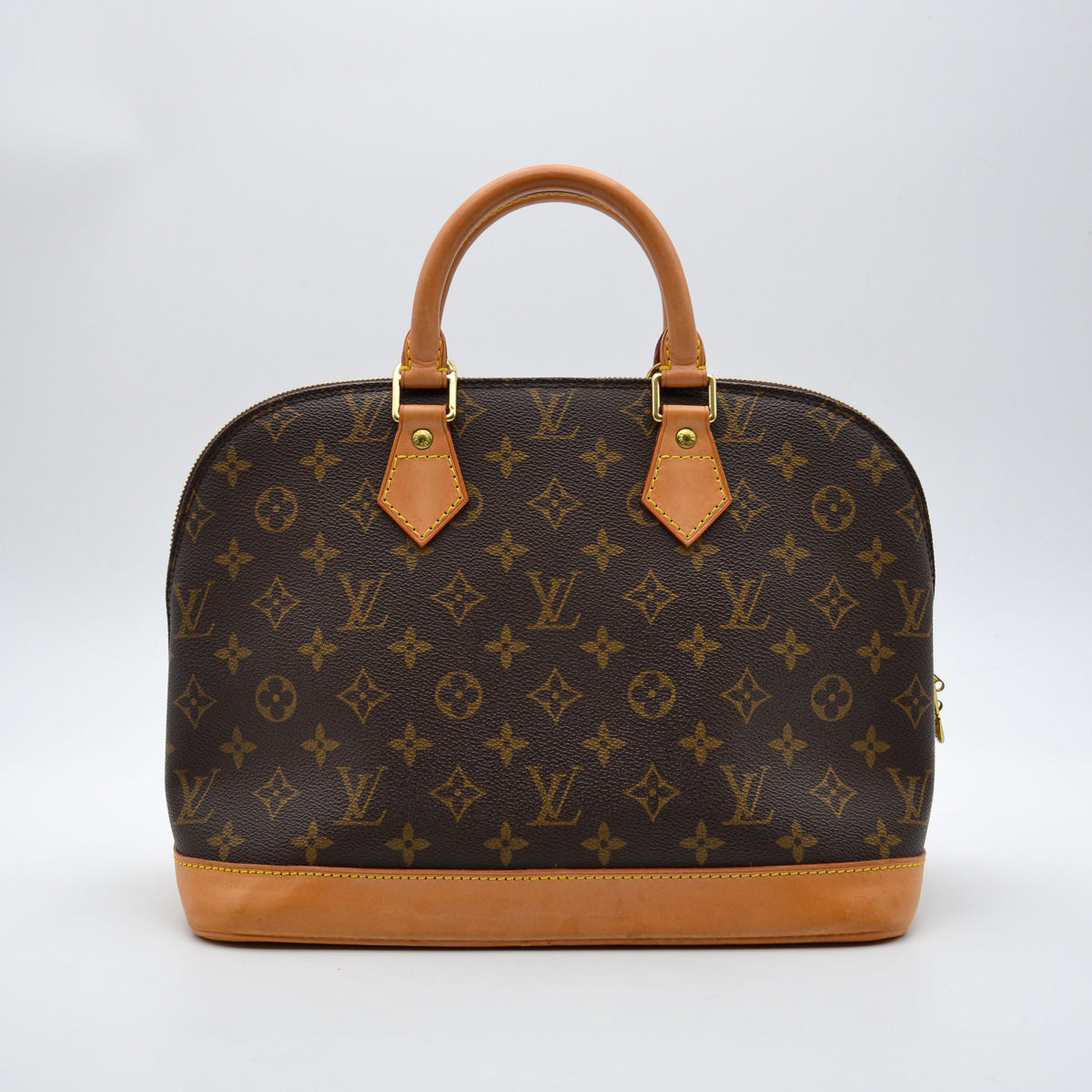
The Alma, whose silhouette dates back to 1934, is one of the most sought-after Louis Vuitton models on the second-hand market, and one of the most counterfeited. Verifying the date code is therefore particularly useful.
Is the date code enough to authenticate a bag?
No. It is a valuable clue, but not proof: many counterfeits reproduce plausible codes. True authentication cross-references several elements: quality of leather and stitching, consistency of the code with the "Made in" marking, hardware, and ideally a professional verification. At RARR Vintage, every bag is authenticated with Entrupy before being listed online.
Our Louis Vuitton pieces
Each Louis Vuitton bag in our selection is checked point-by-point, date code included, then authenticated with Entrupy. See all our authenticated Louis Vuitton bags.
FAQ: Louis Vuitton date code
Do all Louis Vuitton bags have a date code?
No. Pieces prior to the 1980s do not have one, some French Company pieces do not either, and since March 2021, new bags use a chip instead of a physical code.
What should I do if my bag does not have a visible code?
This can be normal for a recent piece, a very old one, or one where the code has worn off. Only professional expertise can confirm authenticity in such cases.
Can you verify a Louis Vuitton date code online?
No. Louis Vuitton does not publish any database of date codes and does not offer an authentication service. Sites that "verify" a code are simply decoding it: they indicate a plausible period and workshop, without proving that the bag is authentic.
How can I know the country of manufacture?
The two letters of the code indicate this, provided you verify that they match the "Made in..." marking on the bag.