Keepall second-hand: authentication & date code
Posted on March 02 2026

Second-hand Keepall: how to authenticate it and read the date code?
Buying a pre-owned Keepall is as much a stylish decision as it is a smart one. A travel icon since the 1930s, the Louis Vuitton Keepall is one of the most coveted bags on the pre-owned luxury market. But with the proliferation of counterfeits, knowing how to authenticate it is essential.
In this expert guide, we explain how to verify a Keepall, where to find the date code, and how to read it correctly. Our goal: to enable you to buy with confidence and invest in an authentic piece.
The Louis Vuitton Keepall: a timeless icon
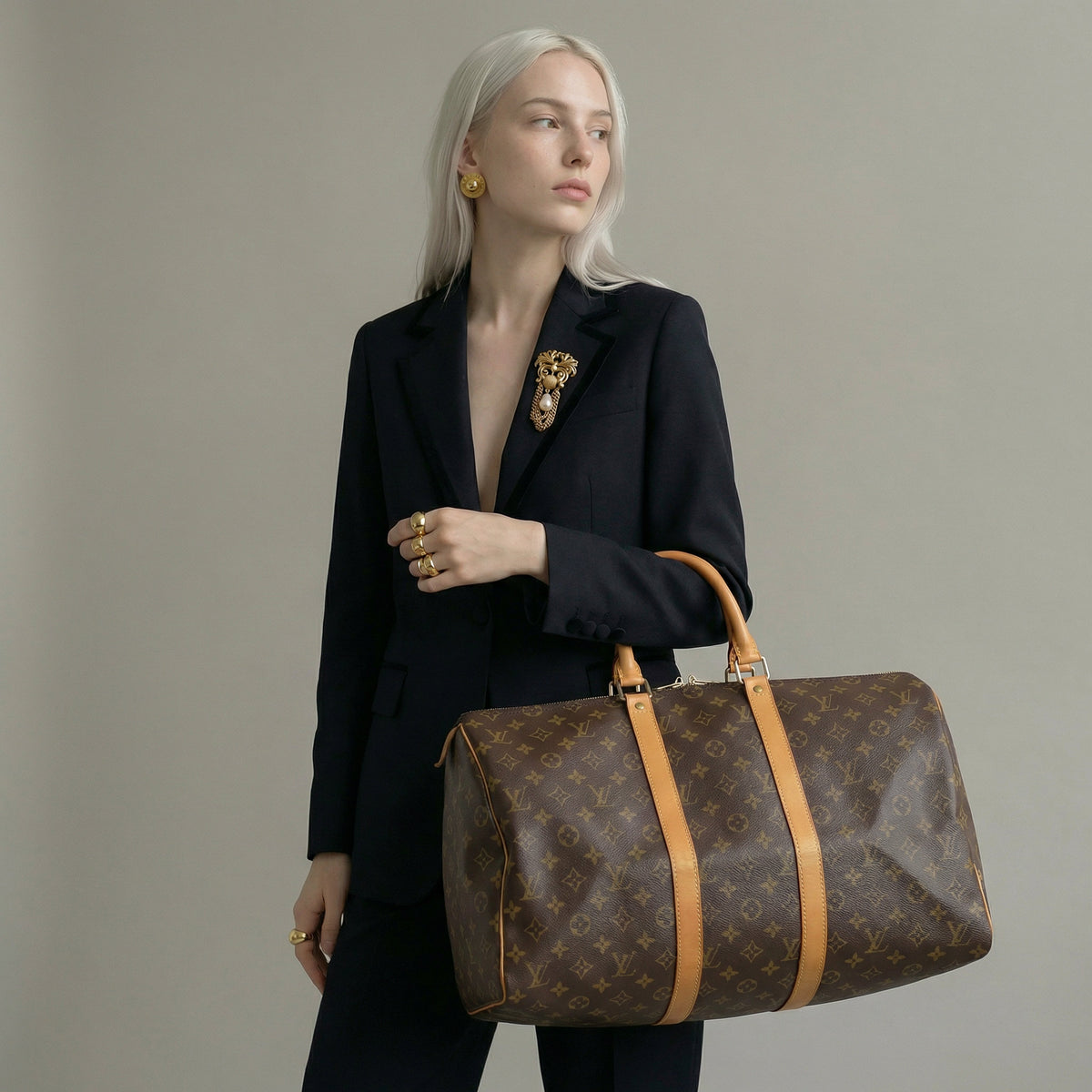
Created in 1930, the Keepall embodies the elegance of travel. Available in several sizes (45, 50, 55, 60) and variations (Monogram, Damier Ebene, Damier Azur), it has become a classic in both men's and women's wardrobes.
Why is the second-hand Keepall so sought after?
-
Its iconic and timeless design
-
Its high resale value
-
Its exceptional robustness
-
Its more accessible positioning on the second-hand market
In the second-hand luxury bag market, the Keepall remains one of the most sought-after models.
Why is authentication essential?
The Keepall is also one of the most counterfeited bags in the world. A fake can seem convincing at first glance. However, certain details give it away.
Buying from a specialist shop like RARR Vintage guarantees you:
-
Professional expertise
-
A thorough inspection of the materials
-
A thorough analysis of the codes and finishes
-
Clear traceability
To understand the official basics of the fight against counterfeiting, you can consult the resources of the INPI .
How to authenticate a second-hand Keepall?
1. Examine the canvas and the pattern
The Monogram or Damier canvas must be:
-
Symmetrical
-
Clear and precise
-
Without a hitch
-
Aligned correctly with the seams
On an authentic model, the pattern is consistent from one panel to the next. Counterfeits often exhibit:
-
Poorly centered patterns
-
Incorrect proportions
-
A shade that is too dark or too light
2. Check the seams
The seams of an authentic Keepall are:
-
Regular
-
Tight
-
Mustard yellow in color (on Monogram)
An important detail: the number of points is often identical from one model to another for the same area.
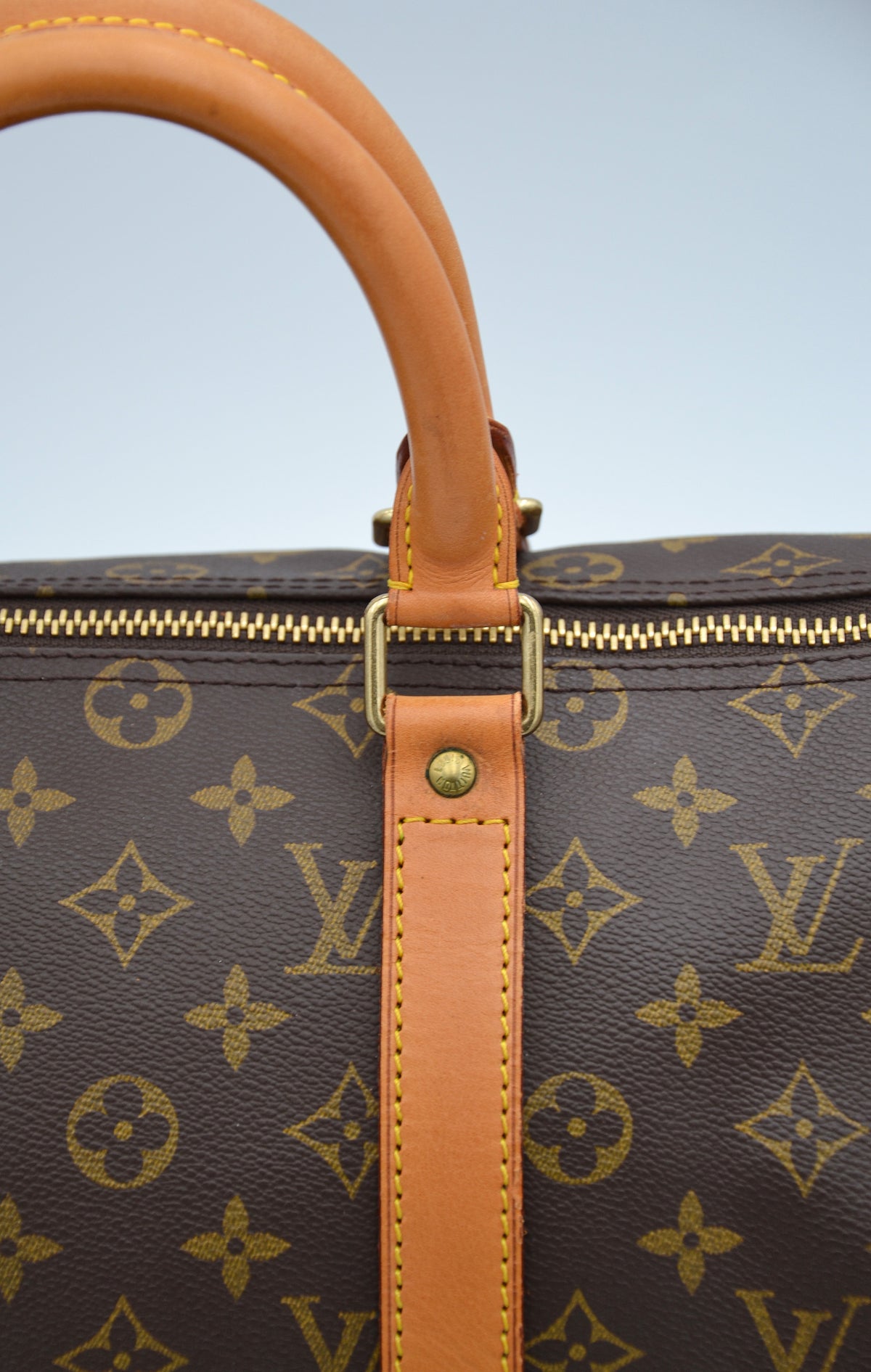
3. Analyze the hardware
The metal components must be:
-
Heavy
-
Well engraved
-
Uniformly golden
The "Louis Vuitton" engraving is clear, never approximate.
4. Observe the handles and the leather
Natural leather (vachetta):
-
It is originally light beige
-
Go with the flow
-
It has a uniform patina
A patina that is too artificial or uniform may indicate a reproduction.
Where can I find the date code on a Keepall?


The date code is a key element for authenticating a second-hand Keepall .
Location of the date code
On a Keepall, you will usually find:
-
Inside the bag
-
On a small leather tab sewn into a side seam
-
Sometimes near the inside pocket (on Shoulder Bag models)
Note: the date code alone does not guarantee authenticity, but it is an important indicator.
How do I read the date code of a Keepall?
The date code system has evolved over the years.
Format prior to 2007
Example: SP1928
-
The two letters indicate the country of manufacture.
-
The 4 digits indicate the month and year
-
1st and 3rd digits = month
-
2nd and 4th digits = year
-
SP = France
1928 = September 2008 (according to specific combination)
Format after 2007
Example: FL2152
-
2 letters = country
-
1st and 3rd digits = week
-
2nd and 4th digits = year
FL = France
2152 = 21st week of 2012
For more general information on luxury authentication systems, you can consult analyses published by The Business of Fashion .
Since 2021: the gradual end of the date code
Since 2021, Louis Vuitton has been progressively replacing date codes with integrated NFC electronic chips.
This means:
-
Some recent Keepalls no longer have a visible date code
-
Authentication relies more on professional expertise
Hence the importance of buying your second-hand keepall from a recognized specialist.
Common mistakes when buying a second-hand Keepall
Here are the most common traps:
-
Relying solely on the attractive price
-
Check only the date code
-
Ignoring the smell (counterfeits often have a chemical odor)
-
Ignore font inconsistencies
A second-hand luxury bag should be examined holistically: materials, finishes, consistency, provenance.
Why buy your Keepall from RARR Vintage?
At RARR Vintage, every Keepall is:
-
Thoroughly inspected
-
Expert Verification
-
Checked down to the smallest detail (canvas, stitching, hardware, date code)
-
Offered with transparency regarding the condition
Discover the collection available here:
👉 https://rarrvintage.com/collections/louis-vuitton
Buying a second-hand Keepall from a professional is an investment in peace of mind.
FAQ – Keepall Second-Hand Authentication
How can you tell if a Keepall is authentic without a receipt?
The invoice is not absolute proof. Authenticity relies on the analysis of materials, stitching, date code, and overall consistency.
Do all Keepalls have a date code?
No. Recent models (after 2021) may be equipped with an electronic chip instead of a date code.
Does the absence of a date code mean it's a counterfeit?
Not necessarily. It can be erased over time or replaced by an NFC chip on newer models.
Which is the best Keepall model to buy second-hand?
The Keepall 50 and 55 in Monogram remain the most sought-after for their versatility and stable value.
Conclusion: Buy a second-hand Keepall with confidence
Keepall second-hand clothing is a sustainable, stylish, and strategic fashion investment. But authentication is a crucial step.
By mastering the key elements — canvas, seams, hardware, date code — you significantly reduce the risks.
For absolute peace of mind, entrust your purchase to an expert in second-hand luxury bags .
Comments
0 Comments
Leave a Comment